

Risotto with garden flavors and shellfish sauce
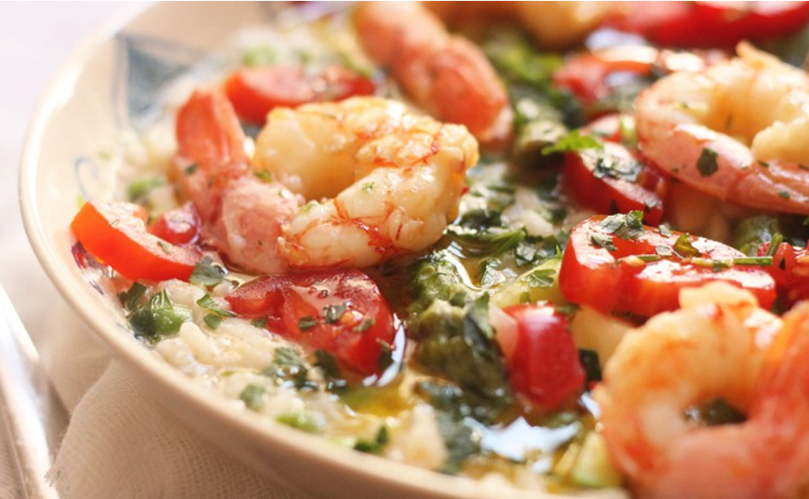
Source: tuttodiabete.it
Presentation
A nutritious recipe, consisting of a first course prepared with rice, lobster, scampi, shrimp, zucchini, peas, asparagus, artichokes, celery, carrots, onions, tomatoes, parsley, white wine, Parmigiano Reggiano PDO, flour, extra virgin olive oil, salt
Ingredients
Serves 4
- 300 g (about 10.5 oz / 1½ cups) Carnaroli rice
- 300 g (about 10.5 oz) lobster
- 100 g (about 3.5 oz / ¾ cup) fresh medium scampi
- 100 g (about 3.5 oz / ¾ cup) shrimp
- 100 g fish bones and trimmings (for stock)
- 50 g (about 1.75 oz / ⅓ cup) zucchini
- 60 g (about 2 oz / ½ cup) peas
- 120 g (about 4.2 oz / 1 cup) asparagus
- 4 small artichokes
- 50 g (about 1.75 oz / ⅓ cup) celery
- 50 g (about 1.75 oz / ⅓ cup) carrots
- 100 g (about 3.5 oz / ¾ cup) onion
- Cherry tomatoes (Pachino), to taste (about 150–200 g / 5–7 oz)
- 1 small bunch parsley
- 50 g (about 3 tbsp) dry white wine
- Parmigiano Reggiano PDO, to taste
- 20 g (about 2½ tbsp) all-purpose flour
- 60 g (about 4 tbsp) extra-virgin olive oil
- Salt, to taste
Method
Start preparing the base for the sauté
Then cut the celery, carrots and half an onion into cubes.
Try to dice that are about the same size.
At this point, put them to fry in a pot with a drizzle of oil.
Add the lobster and scampi to the sauté and cook them for a few minutes.
Remove the crustaceans from the heat, let them cool slightly and separate the pulp from the carapace.
Set the pulp aside and put the shells back in the pot
Deglaze with white wine and let the alcohol evaporate completely
Sprinkle with flour.
Cover everything with two liters of water and cook over medium-low heat until it has reduced by about half.
Season with salt.
Once ready, filter the sauce with a sieve.
Now dedicate yourself to the fish stock (broth).
Prepare the stock with celery, carrot, onion and parsley stalks.
Put them in a pan with a drizzle of oil and add the fish scraps, bones, water. Season with salt and let it cook.
After about an hour, filter the stock in a fine-meshed colander, so that all impurities are eliminated.
In two separate pots, quickly blanch the asparagus, from which you have removed the final part of the stem, and the peas, so that they do not lose their consistency and bright colors.
In a third pan with high sides, put the artichokes, cleaned of the toughest leaves and the internal beard, cut in half with a drizzle of oil and covered with water.
Then dedicate yourself to the zucchini: dice them and sauté them in a pan for a few minutes.
When the vegetables are ready, drain them and set aside.
Now quickly boil the shrimp using a part of the fish stock now ready and set them aside.
Then prepare the shellfish sauce: take the pulp of the scampi and lobster and the sauce obtained from cooking the carapaces.
Finely chop the pulp by adding a few tablespoons of shellfish sauce until you get a homogeneous cream.
Now that the line of ingredients is ready, start with the preparation of the risotto.
In a saucepan, put the finely chopped onion with a drizzle of oil and let it fry for a few minutes.
Add the rice and let it toast and seal for about a minute.
Then start wetting the rice with the fish stock until cooked.
Halfway through cooking the rice, add the shellfish sauce and then all the vegetables.
Turn off the heat and add the Parmigiano reggiano PDO to the rice and close with the lid for about 5 minutes, so that the risotto is creamy.
When ready to serve, decorate the rice with the Pachino tomato cut into small pieces, the open artichokes and a sprinkling of finely chopped parsley.
Allergens
Asparagus: possible reactivity in case of birch allergy
Lobster: fish products included among the allergens in EU Regulation 1169/2011
Artichoke: possible individual intolerance
Carrot: possible individual intolerance and cross-reactivity in case of allergy to pollen of Artemisia, Graminaceae, Composite, Birch
Onion: possible reactivity in case of nickel allergy due to the vegetable’s ability to concentrate it
Flour: contains gluten from cereals included in EU Regulation 1169/2011
Prawns: fish products included among the allergens in EU Regulation 1169/2011
Extra virgin olive oil: unusual allergy; intolerance not described
Parmigiano Reggiano PDO: contains milk allergens
Peas: possible cross-reaction in case of allergy to parietaria. The intake of peas should be avoided in case of favism.
Tomatoes: possible cross-reaction in case of sensitivity to grasses
Rice: (allergy very common in the Far East, almost unknown in Italy and Europe). Possible cross-reaction in case of grass sensitivity
Scampi: fishery products are included among the allergens in EU Regulation 1169/2011
Celery: included among the allergens in EU Regulation 1169/2011
Wine: presence of sulphites included among the allergens in EU Regulation 1169/2011
Zucchini: possible individual intolerance or cross-reaction in case of allergy to Ambrosia
Notes
To be prepared and handled under strict hygienic conditions.
Wine that can also be used in the recipe for children as the alcohol evaporates during cooking but the aroma remains
The ingredients of the dish bring the following benefits:
Asparagus: rich in carotenoids that support the immune system, also suitable for nephropathics, useful for the functioning of the liver for the supply of vitamins. Mineral salts and antioxidants, They provide folic acid linked to the production of serotonin and therefore favorable to good mood and counteract depression
Lobster: supplier of Zinc and selenium, elements that promote the proper functioning of the immune system by hindering the formation of prostaglandins that prevent proper cellular functioning and has a high content of omega 3 fatty acids, which inhibit platelet aggregation (cardiovascular risk factor). Useful for liver function due to the supply of zinc, selenium and omega 3 and 6 fatty acids. Essential fatty acids, such as omega 3 and 6, have an antidepressant effect and maintain efficient nervous system and memory
Artichoke: The cynarin of the artichoke promotes the purifying and detoxifying activity of the liver and also stimulates diuresis and fat deposition and due to the content of mineral salts, vitamins and antioxidants acts to protect the cardiovascular system, and the functioning of the liver. A species that provides folic acid linked to the production of serotonin and therefore favorable to good mood and counteract depression
Carrots: rich in vitamins (B1, B2, C, PP, E, D), carotenoids, minerals and active ingredients that support the functionality of the immune system and ophthalmic, diuretic and healing functions and act to protect the cardiovascular system. Also suitable for nephropathic patients and useful for the functioning of the liver for the contribution of vitamins, mineral salts and antioxidants. They provide folic acid linked to the production of serotonin and therefore favorable to good mood and counteract depression
Onion: it is rich in selenium which supports the immune system and with the ability to stabilize blood glucose at normal values; it provides quercetin, a flavonoid that helps contain cholesterol and triglyceride levels in the blood, parameters related to cardiovascular risk, which also supports liver function by promoting the purification of the body. Also indicated for nephropathic patients, it is a good diuretic that prevents kidney stones. It provides folic acid linked to the production of serotonin and therefore favorable to good mood and counteract depression
Flour: provides B vitamins (thiamine, niacin, riboflavin and folate), which are important for energy metabolism and the functioning of the nervous system.
Prawns: they provide zinc and selenium, elements that promote the proper functioning of the immune system by hindering the formation of prostaglandins that prevent good cellular functioning and has a high content of omega 3 fatty acids, which inhibit platelet aggregation (cardiovascular risk factor). Useful for liver function due to the supply of zinc, selenium and omega 3 and 6 fatty acids. Essential fatty acids, such as omega 3 and 6, have an antidepressant effect and maintain efficient nervous system and memory
Extra virgin olive oil: source of Vitamin E that protects the immune system from harmful fatty acids
Parmigiano Reggiano PDO: useful for the proper functioning of the liver. The presence of tryptophan helps to counteract depression
Peas: rich in vitamin C, the antioxidant par excellence that fights free radicals and supports the immune system, and provide mineral salts, vitamins and antioxidants that act to protect the cardiovascular system; also suitable for nephropathic patients. Useful for the functioning of the liver for the supply of vitamins, mineral salts and antioxidants. Especially if consumed with the peel, it provides folic acid linked to the production of serotonin and therefore favorable to good mood and counteract the depressed
Tomato: rich in vitamin C, the antioxidant par excellence that fights free radicals and supports the immune system, and provides mineral salts, vitamins and antioxidants that act to protect the cardiovascular system; also suitable for nephropathic patients. Useful for the functioning of the liver for the supply of vitamins, mineral salts and antioxidants. Especially if consumed with the peel, it provides folic acid linked to the production of serotonin and therefore favorable to good mood and counteract depression
Parsley: rich in carotenoids that support the immune system and mineral salts, vitamins and antioxidants that act to protect the cardiovascular system; also suitable for nephropathic patients and useful for the functioning of the liver for the supply of vitamins, mineral salts and antioxidants
Rice: due to its modest protein content, it is suitable for nephropathic and phenylketonuric patients; since it is an antiuric food, it is recommended in case of gout and hyperuricemia. It stimulates the synthesis of serotonin which counteracts depression and promotes good mood
Salt: essential for the balance of body fluids and for the transmission of nerve impulses, it is however to be consumed respecting the limit of 5 g per day according to the indications of the WHO so as not to promote arterial hypertension and consequent increase in the risk of cardio-cerebrovascular diseases starting from myocardial infarction and cerebral stroke; to be limited as much as possible in the case of nephropathy.
Scampi: provides fats consisting of polyunsaturated fatty acids, such as eicosapentaenoic acid (EPA) and docosahexaenoic acid (DHA), which are important for heart and brain health; Zinc and selenium, elements that promote the proper functioning of the immune system and liver. Essential fatty acids, such as omega 3 and 6, have an antidepressant effect and maintain efficient nervous system and memory
Celery: rich in carotenoids that support the immune system and mineral salts, vitamins and antioxidants that act to protect the cardiovascular system and useful for the functioning of the liver for the supply of vitamins, mineral salts and antioxidants. Suitable for those with cholesterol problems, as it promotes its disposal. A species that provides folic acid linked to the production of serotonin and therefore favorable to good mood and counteract depression
White wine: (moderate consumption) counteracts bad cholesterol and raises the levels of good cholesterol, reducing the risk of heart attack and stroke and has a purifying and detoxifying activity favorable to the proper functioning of the liver
Zucchini: provides flavonoids (Vit. P), antioxidants that enhance the action of Vit. C in favor of the immune system and mineral salts, vitamins and antioxidants that act to protect the cardiovascular system; also suitable for nephropathics; useful for the functioning of the liver for the supply of vitamins, mineral salts and antioxidants. They provide folic acid linked to the production of serotonin and therefore favorable to good mood and counteract depression
Safety / Intended use
Product also intended for subjects with:
- Anorexia – Weight Loss
- Mucositis (inflammation and injury of the oral cavity) only well cooked
- Xerostomia (dry mouth) if well cooked
Not recommended in case of:
- Dysphagia (problems chewing and swallowing)
- Diarrhea