

Brioche
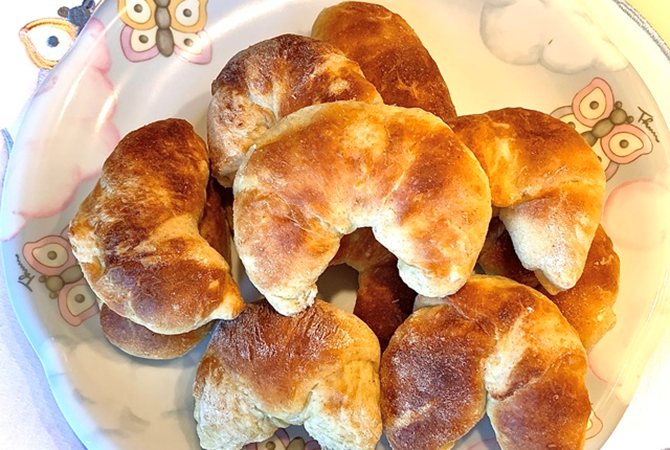
Source: renalizie.it
Presentation
Baked product or dessert for breakfast or snack consisting of croissants prepared with flour, eggs, yeast, milk, butter, sugar and salt
Ingredients
for 18 brioche:
Flour 500 g (17.6 oz)
2 Eggs
Water 60 g (2.1 oz)
Fresh yeast 12 g (0.42 oz)
Grated zest of 1 orange
Milk 100 g (3.5 oz)
Butter 60 g (2.1 oz)
Sugar 40 g (1.4 oz)
Salt 5 g (0.18 oz)
Method
Dissolve the yeast in the slightly warm water
Pour over 150 grams of flour.
Knead until you get a smooth ball (add a few tablespoons of water if the dough is too firm)
Let it rise for about 30-40 minutes
Mix the remaining 350 grams of flour with the milk
Then add the two eggs, sugar, salt and orange peel.
Knead the dough well and only at the end add the butter a piece at a time.
Take the first dough and open it on the work surface.
Place the second dough and, closing it inside the first, knead with your hands until the two mixtures are perfectly blended.
Let rise for 3 hours at room temperature.
When the dough is ready, turn it over on the work surface and divide it into as many pieces as the brioscine you want to get.
Roll out with a rolling pin and make the brioscine; You can also make dumplings. Place the brioscine spaced out on parchment paper and let rise for another 2 hours.
Bake in the oven at 180 ° for 10 minutes in a static oven.
Allergens
Orange: possible individual intolerance; possible cross-reaction in case of grass pollen allergy
Butter: milk allergens (except in clarified butter) if not clarified
Flour: contains gluten from cereals included in EU Regulation 1169/2011
Milk: included among the allergens in EU Regulation 1169/2011
Egg: included among the allergens in EU Regulation 1169/2011
Notes
To be prepared and handled under strict hygienic conditions.
The ingredients of the dish bring the following benefits:
Oranges: provide flavonoids (Vit. P), antioxidants that enhance the action of Vit. C in favor of the immune and cardiovascular systems: also indicated for nephropathic patients; useful for the functioning of the liver for the supply of vitamins, mineral salts and antioxidants. They provide folic acid linked to the production of serotonin and therefore favorable to good mood and counteract depression
Butter: source of fat-soluble vitamins (A, D, E and K) favorable to the health of the eyes, mucous membranes, bones, immune system and blood clotting.
Flour: provides B vitamins (thiamine, niacin, riboflavin and folate), which are important for energy metabolism and the functioning of the nervous system.
Whole milk: provides vitamins, minerals and antioxidants, promoting metabolism, cardiovascular function, tooth and bone health. The presence of tryptophan helps to counteract depression. Provides and promotes the absorption of fat-soluble vitamins (A, D, E.K)
Salt: essential for the balance of body fluids and for the transmission of nerve impulses, it is however to be consumed respecting the limit of 5 g per day according to the indications of the WHO so as not to promote arterial hypertension and consequent increase in the risk of cardio-cerebrovascular diseases starting from myocardial infarction and cerebral stroke; to be limited as much as possible in the case of nephropathy.
Egg: source of Vitamin E that protects the immune system from harmful fatty acids. Rich in Vitamin D that fights mood disorders
Sugar: if consumed in moderation without contraindications (diabetes, obesity,) it is the main source of energy for the body, improves thinking ability, has a positive effect on mood.
Safety / Intended use
Can be administered in case of:
- Renal impairment
- Dialysis
- Transplantation
Can also be administered in case of:
- Anorexia – Weight Loss
- Nausea and vomiting
Not to be administered with caution to individuals suffering from:
- Constipation with meteorism
- Diarrhea
- Mucositis – Lesions of the oral cavity
- Xerostomia (dry mouth)
- Dysphagia (problems chewing and swallowing)