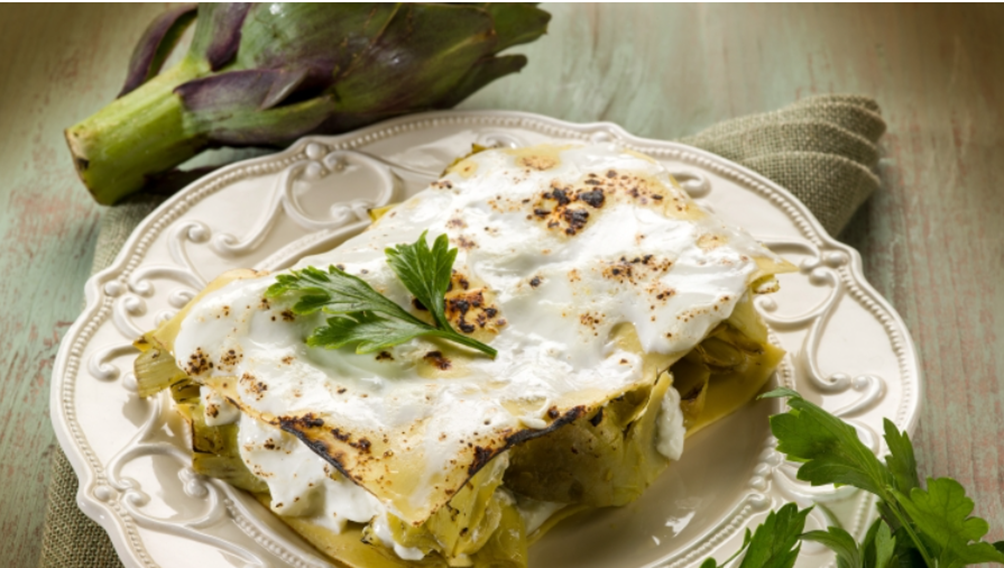
Lasagna with artichokes
Source: era-online.org
Presentation
Protein-free first course consisting of lasagna prepared with lasagna pasta, artichokes, garlic, rice “milk”, breadcrumbs, Parmigiano Reggiano, extra virgin olive oil, béchamel prepared with butter, rice “milk”, flour, nutmeg, salt and pepper.
Ingredients
Serves 4
5 artichokes
500 ml) prepared béchamel sauce (see below)
1 garlic clove
½ glass rice milk
½ glass water
250 g (8.8 oz) egg-free lasagna sheets
2 tablespoons breadcrumbs mixed with 1 tablespoon Parmigiano Reggiano
2 tablespoons extra-virgin olive oil
For the béchamel
35 g (1.2 oz) butter
25 g (0.9 oz) all-purpose flour
½ L (16.9 fl oz) rice milk
Nutmeg, to taste
Salt, to taste
Freshly ground black pepper, to taste
Method
Clean the artichokes, cut them in half
Boil them in water and lemon.
When they are softened, drain them and cut them into thin slices.
Put everything in a pan with a tablespoon of oil and brown for a few minutes.
Blend the cooked artichokes until creamy.
Prepare the béchamel sauce by dissolving the flour with a little cold milk.
Once you have a lump-free cream, add the rest of the milk, mixing well.
Put on the stove over low heat and continue stirring.
When cooked, add the butter.
Allow the butter to melt completely.
Add nutmeg, a pinch of salt and pepper to taste.
When the cream is smooth and velvety, turn off the heat: the béchamel will be ready.
Boil the lasagna sheets in plenty of water for a few minutes.
Spread a layer of béchamel sauce on the bottom of a small baking dish, then a layer of pasta, another of béchamel, one of artichoke cream and the pasta again.
Continue alternating the ingredients in this way until they are used up.
Finish with a layer of béchamel sauce that you sprinkle with breadcrumbs and Parmigiano Reggiano cheese.
Bake the artichoke lasagna at 180 ° for about 30 minutes.
Allergens
Garlic: very rare cases of garlic reactivity reported
Butter: milk allergens (except in clarified butter) if not clarified
Artichoke: possible individual intolerance
Protein-free flour: gluten-free
Nutmeg: possible reaction in case of intolerance to spices
Extra virgin olive oil: unusual allergy; intolerance not described
Low protein bread: low gluten
Parmigiano Reggiano PDO: contains milk allergens
Protein-free pasta: made from gluten-free flours
Pepper: possible cross-reactivity in case of intolerance to spices
Rice: (allergy very common in the Far East, almost unknown in Italy and Europe). Possible cross-reaction in case of grass sensitivity
Notes
To be prepared and handled under strict hygienic conditions.
“Milk” is a very common term but by law it can only be used for the mammary secretion of animals. In fact, in 2017 the Court of Justice of the European Union prohibited the use of the term “milk” for plant products.
It is therefore correct to speak of a drink
The ingredients of the dish bring the following benefits:
Garlic: has immune-stimulating properties, promotes liver function and the elimination of waste metabolites. It also has hypocholesterolemic, lipid-lowering, antiplatelet, hypotensive and hypoglycemic properties that promote cardiac function.
Artichoke: The cynarin of the artichoke promotes the purifying and detoxifying activity of the liver and also stimulates diuresis and fat deposition and due to the content of mineral salts, vitamins and antioxidants acts to protect the cardiovascular system, and the functioning of the liver
Protein-free flour: indicated in case of kidney failure or liver dysfunction.
Nutmeg: source of vitamin A, carotenoids and manganese with antioxidant properties favorable to the proper functioning of the immune system
Extra virgin olive oil: source of Vitamin E that protects the immune system from harmful fatty acids
Parmigiano Reggiano PDO: useful for the proper functioning of the liver
Protein-free pasta: containing protein in quantities not exceeding 1%, suitable for nephropathic patients
Pepper: contains piperine, a powerful antioxidant; It improves insulin sensitivity by reducing cholesterol levels and activating metabolism. Recommended for people with cardiovascular problems.
Rice: due to its modest protein content, it is suitable for nephropathic and phenylketonuric patients; since it is an antiuric food, it is recommended in case of gout and hyperuricemia.
Safety / Intended use
Product also intended for subjects with:
- Constipation
- Nausea and vomiting
- Mucositis (Inflammation and lesions of the oral cavity) only in the case of pasta and vegetables that are very cooked and tender.
In case of Dysphagia (problems with chewing and swallowing) administer only if cut into small, soft pieces.
Not recommended in case of:
- Diarrhea